
LegalAI[Space]

Trust deeds read, points researched, drafts produced, and nothing said that cannot be checked.

Load the family's deeds into the matter, ask the narrow question, and get an answer with the clause quoted and the authority checked before you rely on it.

Private client

Document Review · Hartwell matter · contract screen0/12 filled
DocumentParties and effective dateTEXTTerm and renewalTEXTLimitation of liabilityTEXTGoverning lawTEXT
nda-hartwell-meridian.txt
saas-agreement-northgate.txt
board-minutes-hartwell.txt
A grid of deeds and appointments, the operative wording quoted behind each cell.

Before

Six deeds, four wills, two nil-rate-band discretionary trusts and a letter of wishes from 1998 all have to be read before anyone can advise on what a 2016 deed of appointment actually did.

Private client questions rarely have a leading case with a headnote; they have a statutory provision, an HMRC manual page and a first-instance decision, and assembling those takes an afternoon for four paragraphs.

A file that goes wrong in this practice goes wrong in twenty years, in front of a beneficiary with a solicitor, which is not where you want a fabricated citation to surface.

After

The Research Agent reads the statute, the HMRC manual and the first-instance decision, runs a treatment pass on the case law, and writes the memo with every authority checked before you read it.

The family's deeds and appointments go into a grid you build yourself: settlor and trustees, class of beneficiaries, powers of appointment, each cell carrying the quoted operative wording.

The advice letter goes out as Prepare for Client Update: short sentences, no Latin, no section numbers in the body, ending with the decision the family actually needs to make.

An elderly couple with their solicitor at the kitchen table reviewing a will.

01

Grounded on the matter

The scanned deeds, wills and appointments go into the matter and are converted on upload, and the Research Agent reads what the file actually contains rather than a general account of how a nil-rate-band trust usually works.

See how matters work
Matters · Project Halcyon · SPA warranties and disclosureOpen

Project Halcyon: SPA warranties and disclosure

Buy-side warranty review, disclosure analysis and cited due-diligence grid.

Client
Halcyon Bidco Ltd
Reference
WC-2026-0412
Practice area
Corporate / M&A
Jurisdiction
England and Wales
Responsible partner
E. Vance
No conflict check on file.

Chat, on this matter

Compare warranties with the disclosure letter.

Three high-priority exceptions require action: the unregistered charge, the change-of-control right and the tribunal claim.

Send a message… (@ to mention tools)BalancedPrepare for
  1. 25 Aug

    Disclosure exceptions matrix

    Chat

  2. 21 Aug

    Disclosure exceptions matrix

    Run · completed · 560 credits

  3. 18 Aug

    Project Halcyon: Disclosure Letter

    Document · indexed

  4. 16 Aug

    Project Halcyon: Share Purchase Agreement

    Document · indexed

  5. 4 Aug

    Matter opened

    Opened

The matter for a family settlement, with two beneficiaries flagged against an old estate file.

02

A memo, not a chat

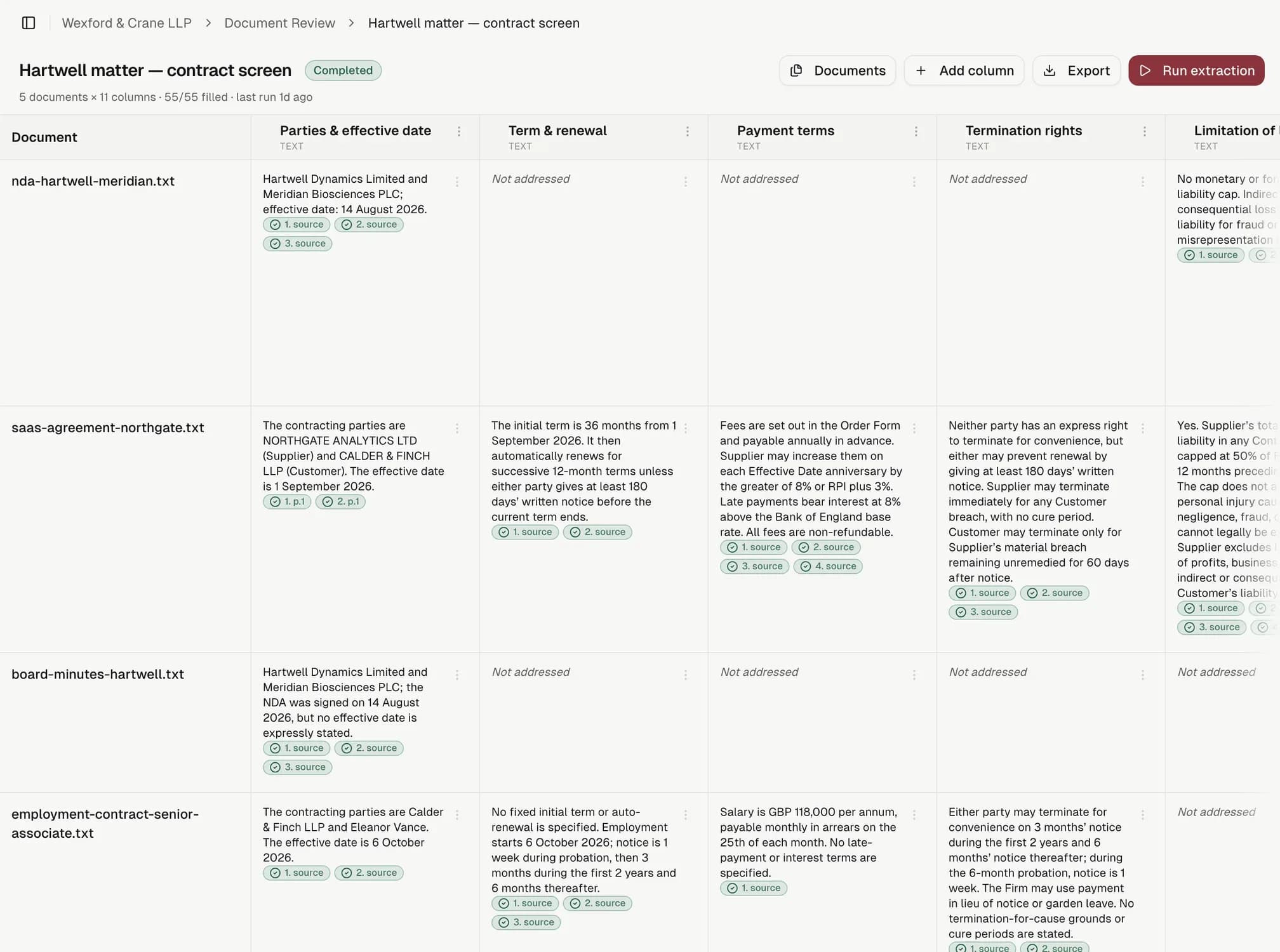
There is no seeded private client playbook, so you write the columns yourself: date of settlement, class of beneficiaries, powers of appointment, whether the deed has been varied. Every cell comes back with the quoted wording behind it, so the partner checks the quote rather than the summary.

See the review grid
Document Review · Hartwell matter · contract screen
A review grid: documents down the side, questions across the top, and a cited answer in every cell.
A grid of deeds and appointments, the operative wording quoted in each cell.

03

Verified, then shareable

The HMRC manual page and the first-instance decision behind a reservation-of-benefit question are each checked against the source before the memo is finished, arriving verified, needs a check or not found. The advice letter shares to the client's accountant as a passcode link with an email gate.

See how verification works
Authorities · 14 · Where we looked
#ReferenceVerdict
1

Tillman v Egon Zehnder Ltd

[2019] UKSC 32
not yet checked
2

Working Time Regulations 1998

SI 1998/1833, regs 4 to 5, 10 to 14
not yet checked
3

Coppage v Safety Net Security Ltd

[2013] EWCA Civ 1176
not yet checked
4

UK GDPR, Articles 6 and 9

Retained Regulation (EU) 2016/679
not yet checked
5

Employment Rights Act 1996, s 1

c 18
not yet checked
6

Harlow v Artemis International

[2008] EWHC 1126 (QB)
not yet checked
The statute and the HMRC guidance behind a tax point, each carrying its own verdict.

What a run costs.

Usage is metered in credits per matter, so a research answer on a thirty-year file costs what it costs and sits on the record if the file is ever queried.

See pricing

What you will say before you try it.

This file will still be open in twenty years.
The matter timeline holds every run, share and check for as long as the matter is open, and the register exports as a spreadsheet or a printable audit bundle, so the file shows what was read, what was checked, and who signed it off, whenever it is queried.
See the audit register
A private client point is narrow, not famous, and a general assistant will just make something up.
The Research Agent retrieves from legislation.gov.uk with point-in-time versions and the HMRC manuals through the Regulator Retrieval sub-agent, and every authority it relies on is checked against the source it cites before the memo is finished.
See how verification works
These documents are the most personal thing a client owns.
Files sit in Microsoft Azure UK, encrypted in transit and at rest, and are never used to train a model. A client sees the file only through a share link you deliberately create, and it can be revoked at any time.
Read the security statement
Start free

Read one of your own trust files.

Ten minutes, no card. Ask one narrow question you already know the answer to.