AI that does the legal legwork
Not a chatbot. These agents do the work: research, contract review, compliance monitoring, audit, and every step is checked, compliant, and logged.
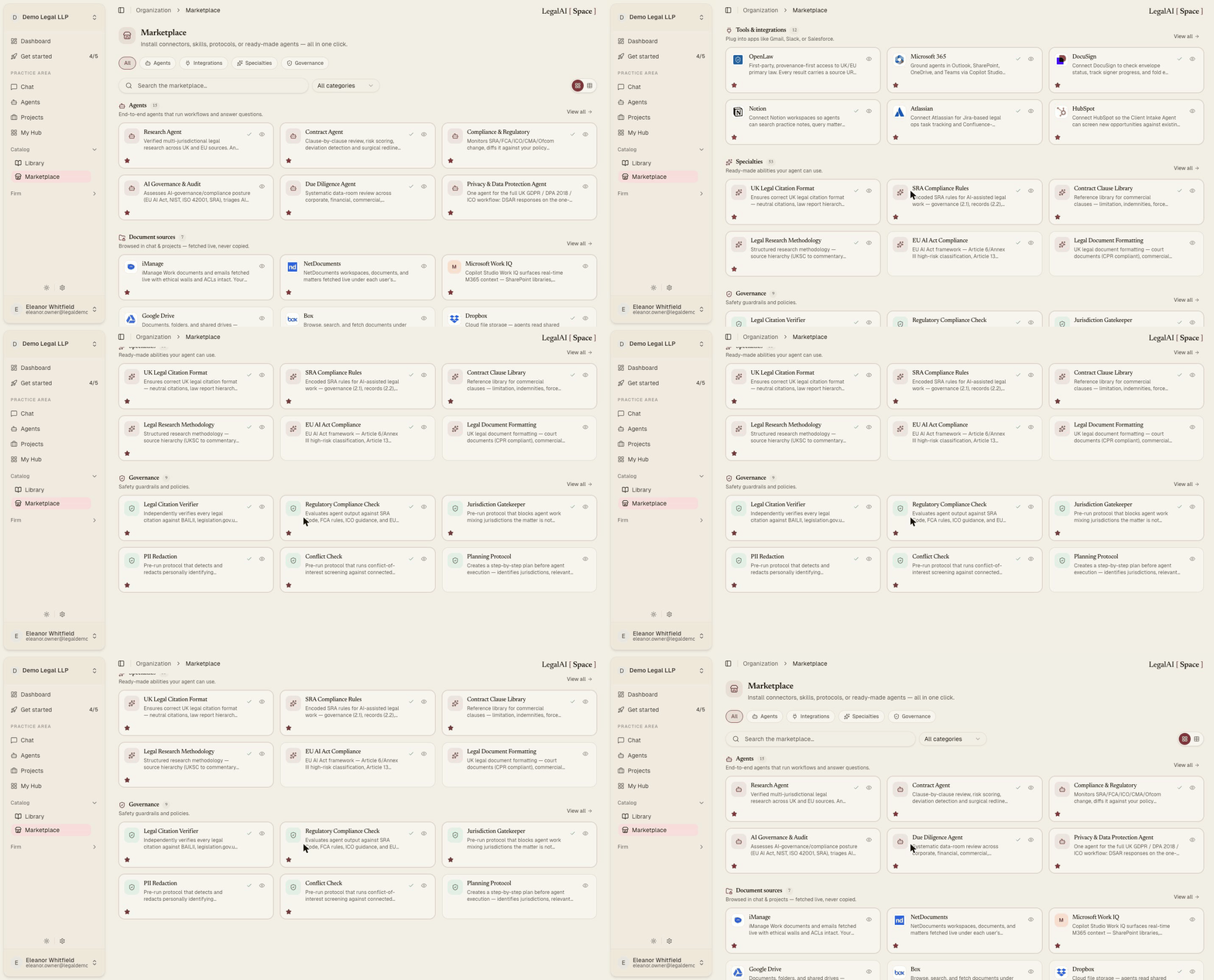
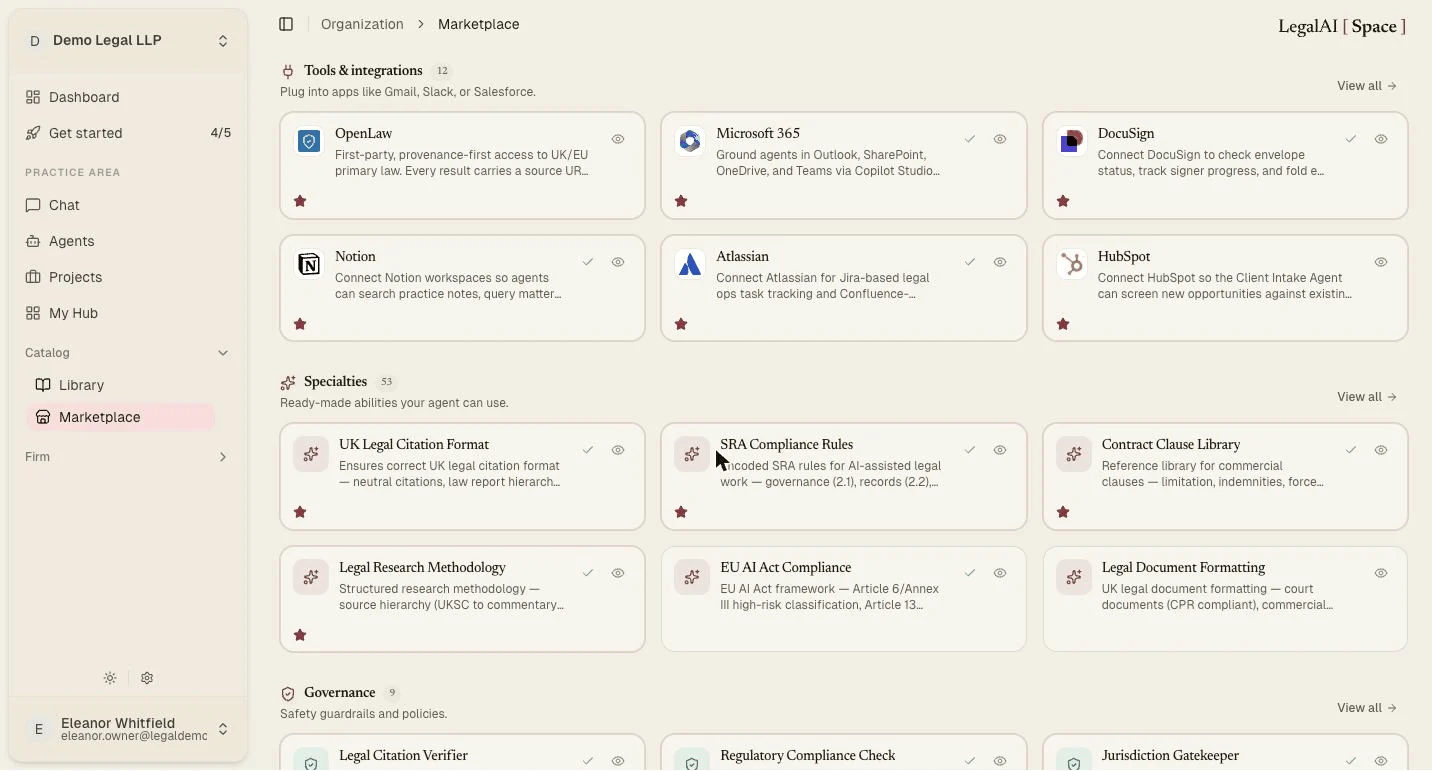
The live agent marketplace, captured from the real app. Launch any agent on a real matter and watch the governance run.
Three ways to work
From a quick question to a custom agent.
However you start, the same governance runs underneath: every output verified, compliant, and logged.
Ask in plain English
Pose a question and get a grounded answer with its sources, for the quick checks that don't need a full deliverable. Every answer still runs the verification gates.
New Chat · grounded, cited, logged
Run a specialist agent
A specialist agent for every kind of legal work: research, contract review, due diligence, compliance, drafting and more. Each owns a real workflow and hands back the finished thing, not a chat reply. They all run on the same governed pipeline: checks before they start, citations verified against source, a signed draft at the end.
15 agents, grouped by UK practice area
Build your own
Compose an agent from plain-English instructions, your firm's sources and your playbook rules. It inherits the exact same guardrails: custom never means ungoverned.
Same Verify · Comply · Prove pipeline
The full library
An agent for every practice area
Every agent is purpose-built for a defined slice of legal work, and every one runs through the same Verify, Comply, Prove governance. Choose an area to see what each agent does.
Research & Intelligence
Find the law, find what changed, find what your firm already knows.
Know-How
Your firm's know-how, surfaced in context
Precedent and prior-matter search that reads the context, across iManage, NetDocuments, SharePoint, and your wikis
Radar
One configurable watch, running in the background
A single watch defined as watch-target, cadence, and destination, configured in minutes
Transactions
Review, draft, and diligence the documents that move a deal.
Due Diligence Agent
Data-room review, every finding traceable
Documents sorted and prioritised across the whole data room
Drafting Agent
First drafts from your own precedents
Documents drafted from plain-English instructions, with the context understood
IP & Technology
Clearance, freedom-to-operate, and licence compliance
Trademark clearance against the UKIPO and EUIPO registers
Risk & Compliance
Watch the regulators, govern your AI, protect the data, open clients cleanly.
Compliance & Regulatory
Regulatory change, diffed against your policies
Live monitoring across the SRA, FCA, ICO, CMA, and Ofcom
Client Intake
SRA-compliant onboarding, end to end
Conflict checking across the firm's client and matter database
Privacy & Data Protection
The full UK GDPR and DPA 2018 workflow
DSAR handling on the statutory one-month clock, with the deadline tracked
Custom Agent
Your workflow. Our governance.
Your own instructions: set exactly what the agent does, how it reasons, and what it produces
Disputes & Practice
Run contentious work and keep every matter on track.
Matter Management
Deadlines mapped, milestones planned
Dates and deadlines extracted from documents, correspondence, and orders
Litigation & Disputes
Contentious work, drafted for a litigator
Element-by-element claim charts, mapping the facts to each element of the cause of action
Employment
E&W employment, drafted for an employment lawyer
Dismissal and termination risk assessed against the law and the facts
Spotlight · Horizon Scanning
Know what changed in the law before your clients ask.
Tell it what to watch in plain English. Every scan sweeps SRA, FCA, ICO, CMA and EU sources, dedupes against the register, scores materiality, and lands a judged digest in your inbox, with signed proof of what was covered.
Coverage in your own words
“BNPL and consumer-credit rules affecting our fintech clients” is a complete setup. The agent judges every collected development against it.
Materiality scoring, not a link dump
Each development is scored for scope, penalty risk and implementation effort, so the digest leads with what your practice actually has to act on.
Signed proof of coverage
Every scan records which sources were swept and when. If a client asks “why didn’t we know?”, you can show exactly what was watched.
Radar for the single source that matters
Its companion agent, Radar, watches one chosen source on a schedule, a regulator page, a consultation, a docket, and reports only on change.
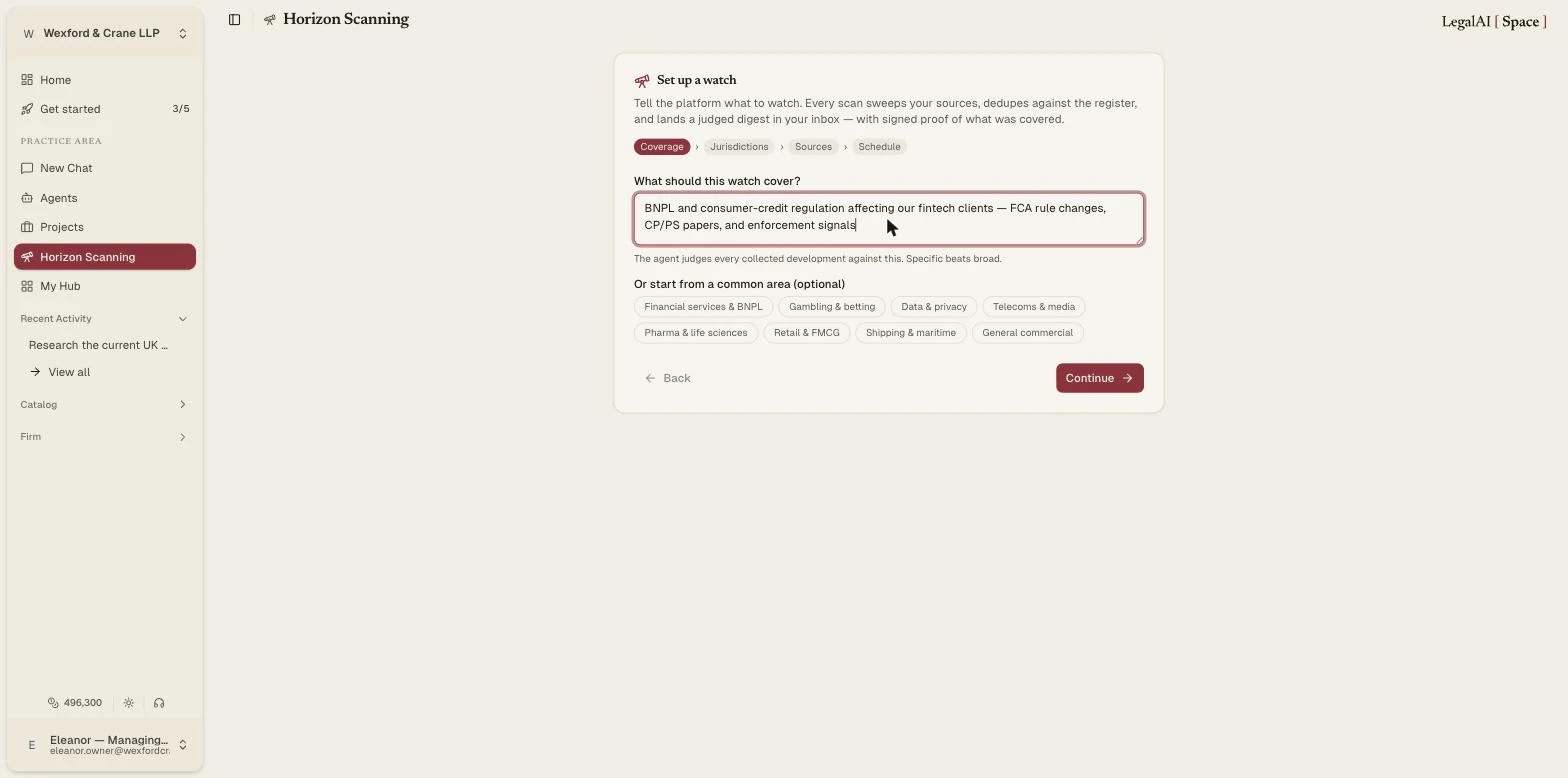
The real two-minute setup: coverage → jurisdictions → sources → schedule. Specific beats broad: the agent judges every development against your wording.
Real outputs
A finished work product
Every agent returns something structured and ready to use. Citations are checked against the real source, risks are scored against your playbook, and your COLP sees it all on one dashboard.
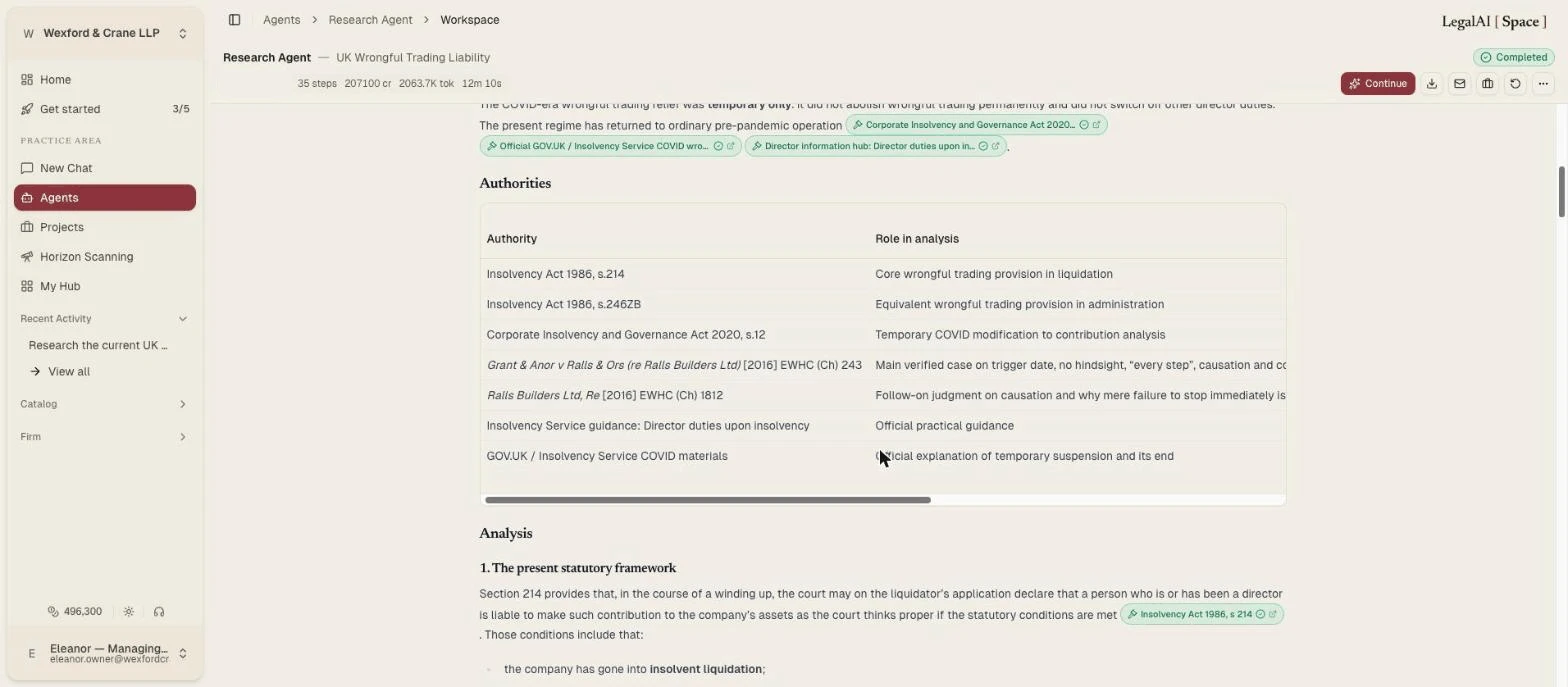
Every authority checked against the real source.
A real run, captured from the live app: every citation carries its verification chip, and the two quotes that didn't match the source word-for-word are flagged for human review, not silently passed through.
Reviewed against your playbook.
Risks ranked by severity, with a confidence level on every clause: each one traced to the playbook rule it came from.

Governance, made visible.
Every agent writes to a hash-chained audit record as it works: runs, gates, verifications, human reviews, and certificates, each one filterable on the COLP's view and exportable in one click for an SRA inspection.
Explore AI Governance & Audit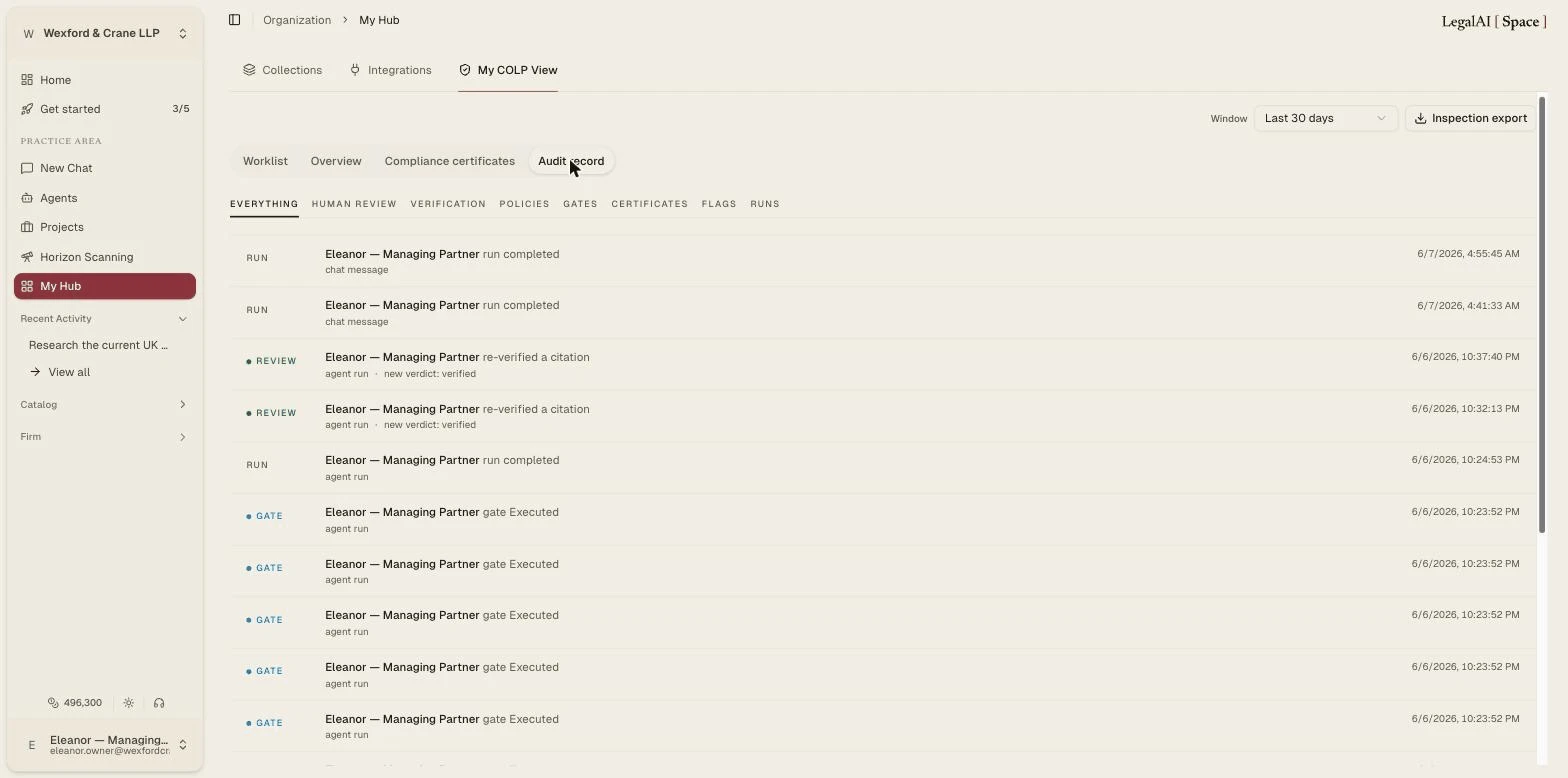
Governed by design
Verify, Comply, Prove
Custom or built-in, the same governance runs behind every agent. Every output goes through all three steps.
Verify
Every citation looked up again and matched word-for-word against the real source.
Comply
SRA Standards, the EU AI Act, and your firm's own rules checked automatically.
Prove
A tamper-proof, signed record of every step.
Governed agents, answered.
What the agents are for now that governance is the product, and how they relate to the AI tools your firm already has.
Still have questions? Talk to the founderFrom the blog
What governed AI work actually involves
How verification works in practice, and why a policy document is not a control.
Ready to put governed AI agents to work?
Try the platform on a real matter, or book a 30-minute pilot call.